

“Life was stable. After the war, I lost my job, my source of income. I came to Wad Elhilew and found myself just sitting at home doing nothing.”
These were the words of Shiraz, one of millions of Sudanese forced to flee their homes due to the war in Sudan.
Back in Khartoum, Shiraz had an office job at a local insurance company. She lived a peaceful, structured life. But when war broke out everything changed. Her family sought refuge in Wad Elhilew locality, an agricultural region in eastern Sudan where the EU Trust Fund (EUTF) is supporting the Netherlands Enterprise Agency (RVO) and Practical Action to improve the income of smallholder farmers, including refugees, displaced people and host communities. There, Shiraz discovered a new path – one she had never imagined before.
A new beginning in agriculture
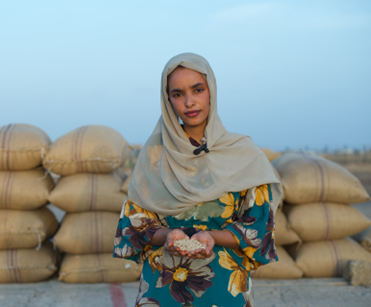
Thanks to the EUTF-funded ‘Agribusiness in Eastern Sudan’ project, Shiraz attended three transformative workshops organised by Practical Action, the first in Agribusiness, the second in farming skills and the third in dairy production. For someone with an office background, the world of agriculture was entirely foreign territory.
“I didn’t know anything about agriculture before.” Shiraz admitted, “I learnt about the project through agricultural societies in Wad Elhilew and through them I managed to access the training. After taking part in these workshops, I began to see farming as an option for me too.” – Shiraz - IDP, smallholder farmer
Shiraz immediately rented a small land and planted sesame. Soon, her rain-fed land was transformed into a thriving sesame farm. Alongside the produce from her home vegetable garden, Shiraz and her family, though still displaced, were now sufficient with stable livelihoods. Shiraz was not only self-sufficient, but also she was providing employment to other people on her farm to help during the harvest season.
--Shiraz’s clip Shiraz_v7.mp4
Empowering thousands across eastern Sudan
Over 24,700 people in Gedarif and Kassala states were supported through this EUTF funded programme to increase their income and improve their livelihoods.
The programme established three farmer field schools and three community centres and successfully increased the participation of refugees, displaced people and women in eastern Sudan in agribusiness activities, with over 9,000 refugees and internally displaced persons (IDPs) benefiting from the training delivered.
With over 60% of its land considered arable, Sudan has huge agricultural potential. It is one of the most fertile lands in Africa with agriculture sustaining the lives of millions of Sudanese families. Yet challenges posed by the unpredictable rain and rising temperatures were severely compounded by the ongoing war, making farming increasingly difficult, especially for smallholder farmers.
The fuel crisis
While Shiraz was taking her first steps into farming, Alrayah Alamein - a 35-year-old farmer from Kassala State – was fighting to save the farm he spent years working on. The instability caused by the war almost lost him everything:
"After the war broke out the price of diesel spiked to around SDG 700,000 ($260) per barrel . We were struggling with access to water. I lost 40% of my banana farm due to the lack of fuel for water pumps. We had to sell our livestock. It was a difficult time."
Alrayah’s struggle to provide fuel for the water pumps to irrigate his land was the struggle of hundreds of other smallholder farmers. Disrupted supply chains and soaring fuel prices meant that even farmers with productive land and years of experience were struggling to maintain their farms. As water pumps sat idle, fertile land began to turn barren.
Supported by the EUTF, Practical Action continued to provide agricultural tools - such as water sprayers for irrigation, rakes, shovels and spades - and agribusiness training to help strengthen the resilience of rural communities. One of their interventions to help improve yields and rehabilitate barren land was the integration of clean energy.
For Alrayah, the installation of solar irrigation systems through the project changed everything:
"The European Union has provided us with a service that we could only dream of. Securing fuel was the biggest threat to us smallholder farmers. We all benefited from the energy supplied through this programme"
14 solar irrigation systems were installed across Kassala and Gedarif states. This provided reliable water to 14 smallholder farmer associations with an approximate membership of 200 farmers and reduced production costs by over 75% in targeted areas. Once barren land now yields a wide variety of vegetables and crops, boosting food security and livelihoods.
With a reliable water source, Alrayah revived his farm, expanding it to include more banana and vegetables like tomatoes and peppers:
“The biggest threat to us was diesel. Now with this energy [solar] our livelihood is completely stable. We don't need anything else. Next I want to secure my children's future and get them to resume their education"
--Alrayah’s clip: Farmer_v7.mp4
For over 30 years Practical Action has worked closely with Sudanese rural communities, helping them adapt to climate change and conflict. In North Darfur, Kassala, Gedaref and Blue Nile, the European Union continues to support Practical Action efforts to strengthen the resilience of vulnerable communities through better farming practices, improved water access, and clean energy.
"For as long as there is water, we can benefit from every seed we plant , God willing" – said farmer Alrayah, with unwavering conviction.
The stories of Shiraz and Alrayah are two of thousands of stories of Sudanese people who refused to give up. They’re persevering through the conflict. Rebuilding amidst the chaos. Holding onto hope and belief in a better future. With the right support and training, they can continue to create new livelihoods and sustain their families, even in displacement.
The European Union has allocated €131 million of funding towards enhancing food security and resilience of rural communities in Sudan and is committed to working with partners to continue supporting the Sudanese people through this conflict.
- Publication date
- 21 November 2025
- Author
- Directorate-General for International Partnerships
- Region and Country
- Regional
- Horn of Africa
- Thematic
- Greater economic and employment opportunities
- Strengthening resilience of communities