

In 2023, violence swept the Sudanese capital city Khartoum forcing millions of people to abandon their homes. As the security situation continued to deteriorate across the whole country, so did the humanitarian situation. With over 10 million people displaced to neighboring states, public resources were crippling under the pressure of an unprecedented influx of displaced people.
Sudan’s health system in particular faces a severe reality. Over two-thirds of hospitals are non-operational, leaving the remaining facilities a fragile lifeline for people in need of urgent healthcare. However, these hospitals too were grappling with shortages in staff, medical supplies and funds to cover essential operational costs.
The European Union, through the EU Trust Fund (EUTF), has been supporting the World Health Organisation (WHO) to sustain hospitals throughout the conflict. Under the project “Strengthening preparedness and response of the health system addressing the current crisis”, immediate healthcare needs have been addressed. A funding of 20,5 Million Euros was directed towards infection control, disease surveillance, providing crucial medical supplies and covering essential operational costs.
Atbara: A City Overwhelmed
One key intervention has been the installation of ten medical waste incinerators in four major states Port Sudan, River Nile, Kassala and Northern State. In Atbara, a city in River Nile State with hundreds of thousands of displaced people, the medical waste burden has reached a crisis level. Dr. Ibrahim Saad, Medical Director of Atbara Teaching Hospital paints a stark picture:
“The city wasn’t prepared to deal with this number of people. The Accidents & Emergencies department at the hospital received 15,000 patients before the conflict erupted. Today, this number has increased by 400% to 60,000 patients.”
Established in 1906, Atbara teaching hospital was set up to serve the community that lived in the city and provide clinical setting for the training of students at the Atbara University medical school. As the city continued to grow so did the hospital. Since the outbreak of the war, the hospital has been on the frontlines of a national health crisis, delivering critical care to patients from across the country. This generated a medical waste crisis of immense scale for the hospital.
For Atbara teaching hospital, this was the first medical waste incinerator to be installed:
"The hospital didn’t have a system for dealing with hazardous medical waste in the past. The conflict exacerbated the situation.” Explains Dr. Saad. “The incinerator has been a cornerstone of the medical waste treatment system. It improves the quality of care we can provide as it helps us to protect patients from catching other infections in the hospital. It also increases the job satisfaction of both staff and visitors” He adds.
The arrival of people from Khartoum has also brought some unanticipated advantages, as noted by Fatma Abbas, a teacher and long-time resident in Atbara:
“Excellent doctors from different specialties have come to work in Atbara now. We also received excellent teachers”, she explains.
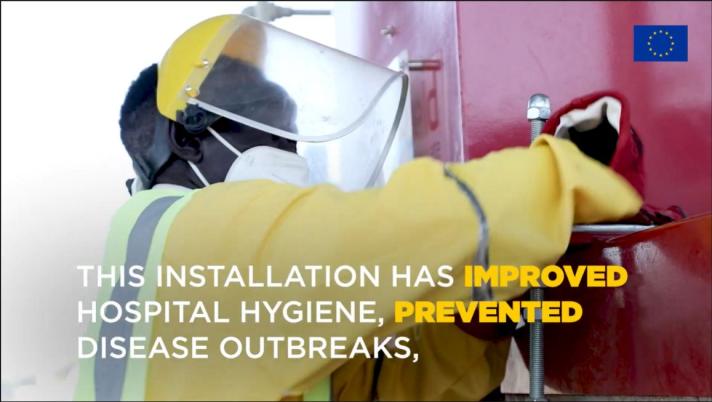
Staff members at Atbara Teaching hospital operating the medical waste incinerator
To watch the full video click here
Expanding Capacity in Port Sudan
Along the Red Sea in Eastern Sudan, Port Sudan Teaching Hospital was also affected by the displacement crisis, functioning as both a transit hub and a refuge for hundreds of thousands of displaced people. Here, an expanded ‘Accidents and Emergencies’ unit, a medical waste incinerator as well as accommodation for displaced doctors were constructed.
Focusing on prevention, preparedness and response when improving health facilities, ensures they meet urgent needs now, and keep serving both local and displaced communities in the future. This nexus approach, which brings together humanitarian development and peace assistance, helps in preventing crises from escalating and leading to further conflict within communities.
The European Union remains steadfast in its commitment to supporting healthcare facilities providing essential medical care for the Sudanese people.
- Publication date
- 8 July 2025
- Author
- Directorate-General for International Partnerships
- Region and Country
- Horn of Africa
- Sudan
- Thematic
- Improved migration management
- Strengthening resilience of communities
- Partner
- WORLD HEALTH ORGANIZATION (WHO)